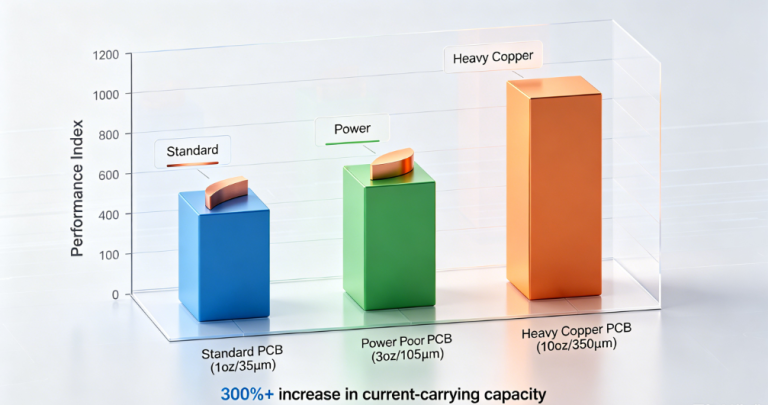
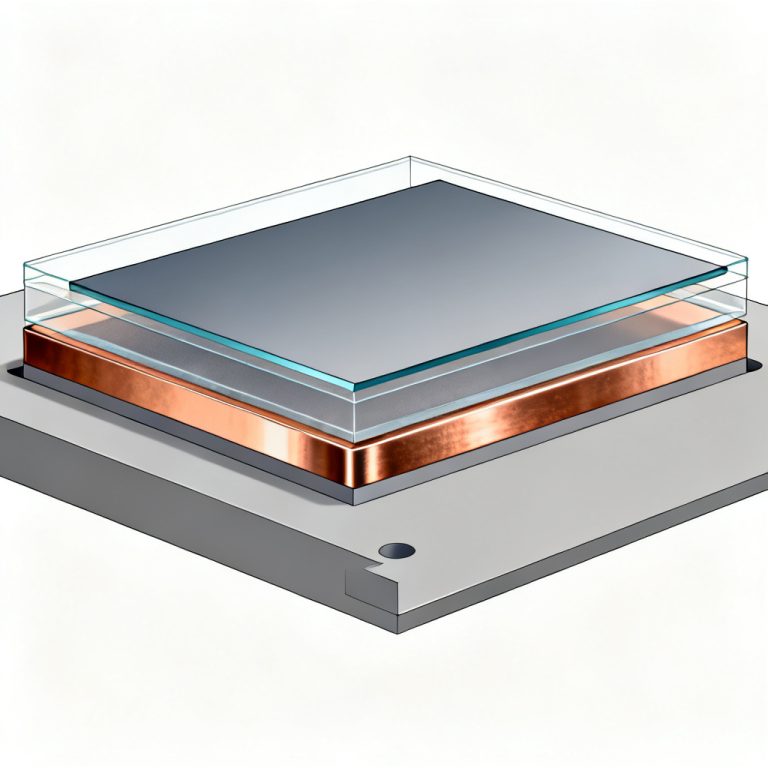
This page is your definitive guide to 10oz 20oz Heavy Copper PCB: High Current Power Boards. In power electronics, standard copper often fails to meet high-current demands. Heavy copper PCBs integrate thick copper traces directly into the substrate, offering superior thermal management and reduced voltage drop for demanding applications like EV power distribution and industrial motor drives.
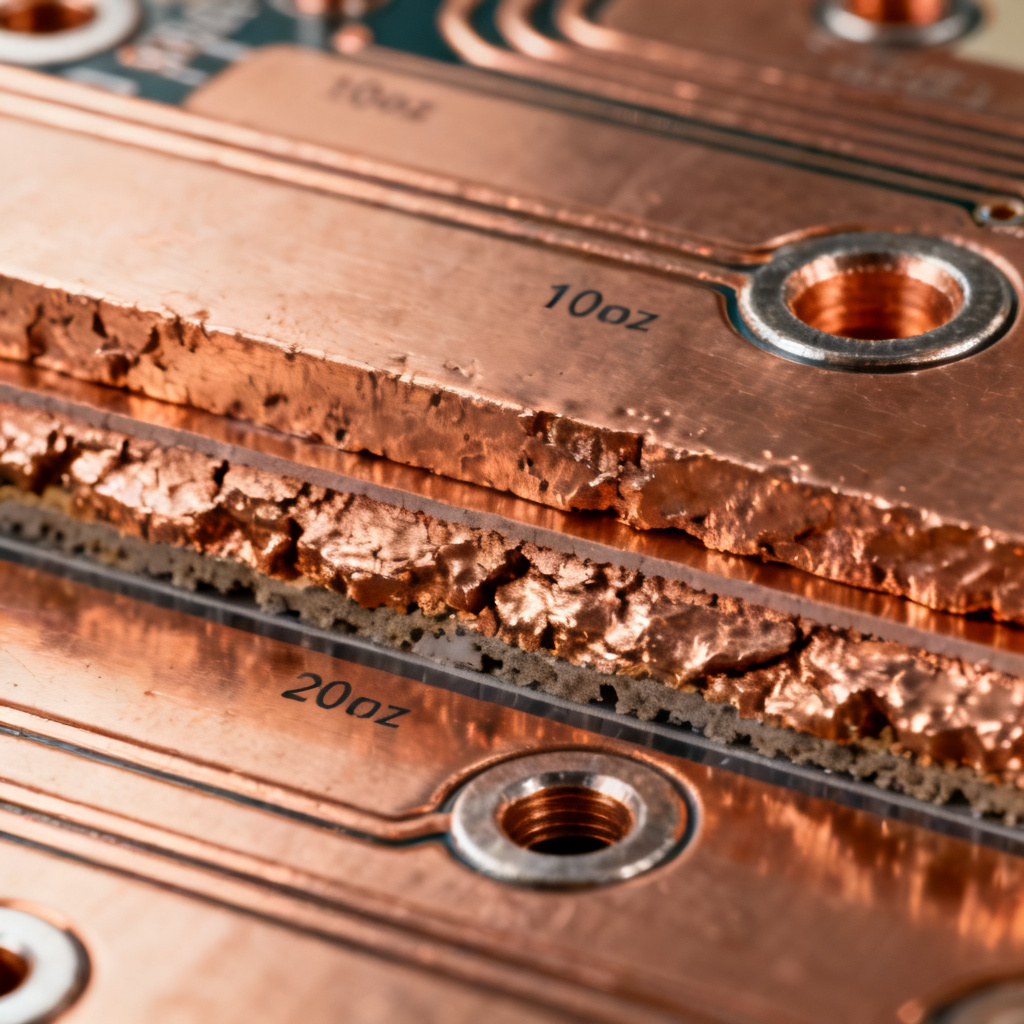
What is a 10oz 20oz Heavy Copper PCB: High Current Power Boards Definition
A 10oz 20oz Heavy Copper PCB: High Current Power Boards is defined by copper thickness exceeding 4oz per square foot. According to IPC-6012, heavy copper starts at 4oz. For high-current power boards, 10oz (350 µm) and 20oz (700 µm) are common specifications. A 10oz trace carries approximately 50-60 amps per inch of width, while a 20oz trace handles over 100 amps per inch, making them ideal for high-current power boards.
10oz Copper: Medium-to-High Power Distribution
10oz copper (350 µm) is a robust choice for battery management systems and high-current relays. Its cross-sectional area provides excellent ampacity for medium-to-high power applications. This specification is widely used in 10oz 20oz Heavy Copper PCB: High Current Power Boards for EV power distribution.
20oz Copper: Extreme High Current Capacity
20oz copper (700 µm) represents the extreme end of standard heavy copper manufacturing. It is used for main power buses in industrial equipment and large-scale energy storage systems. A 20oz trace reduces resistance by 10x compared to 2oz, minimizing I²R losses in high-current power boards.
Why Choose 10oz 20oz Heavy Copper PCB: High Current Power Boards Advantages
The primary advantage of 10oz 20oz Heavy Copper PCB: High Current Power Boards is superior current carrying capacity. Using IPC-2152, a 1-inch wide 20oz external trace safely carries over 150 amps with a 20°C temperature rise. This eliminates external bus bars, reducing assembly complexity.
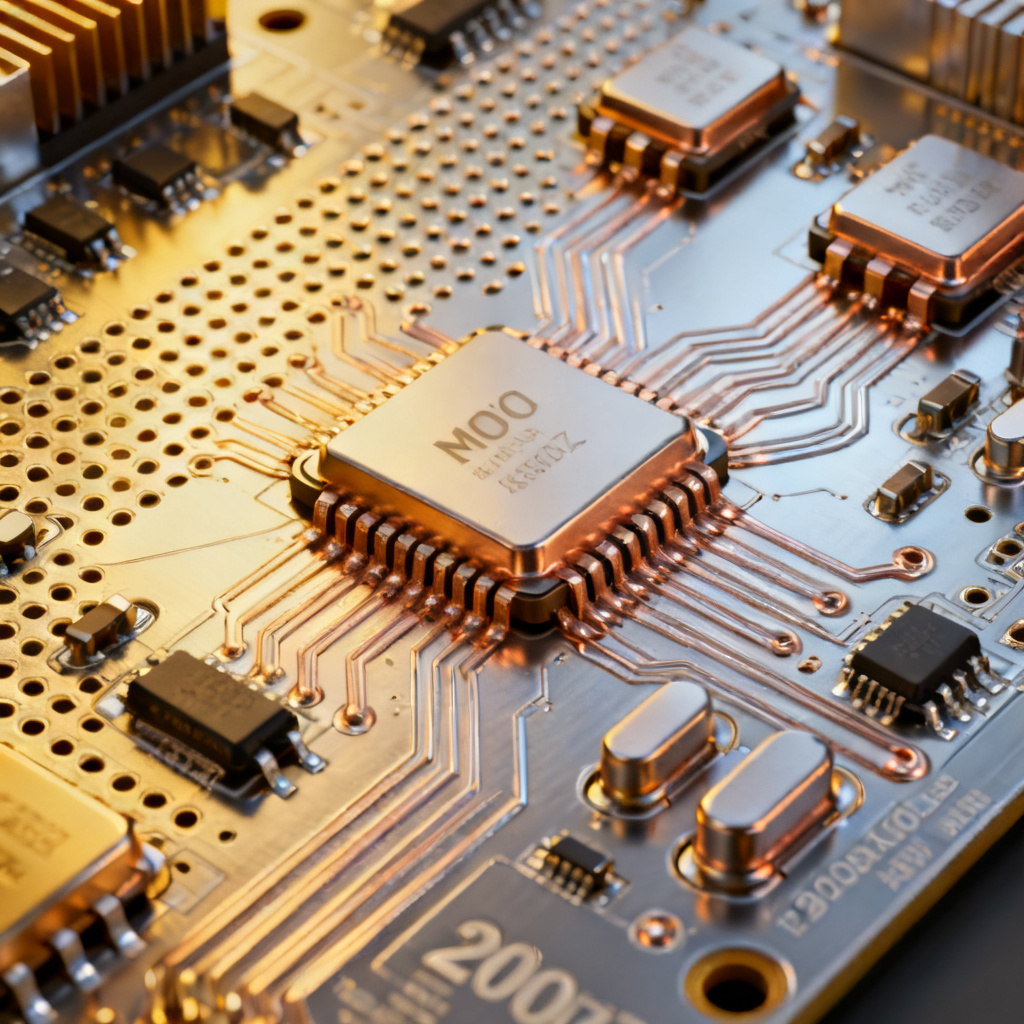
Excellent Thermal Management for High Current Power Boards
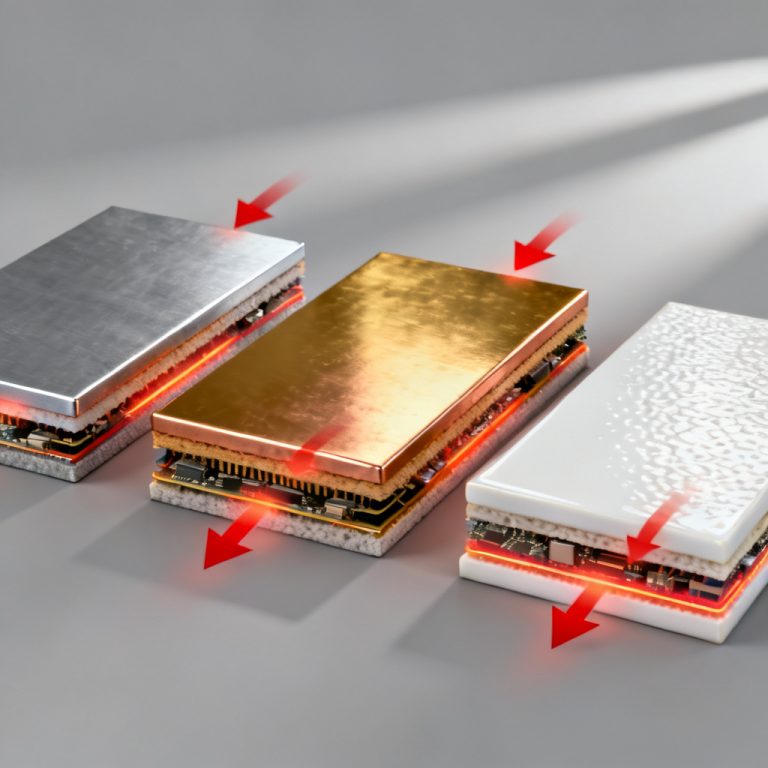
Thick copper in 10oz 20oz Heavy Copper PCB: High Current Power Boards acts as both conductor and heat sink. It effectively spreads heat away from hot components like MOSFETs and IGBTs, reducing hot spots by 30-50% compared to standard copper. This allows higher power density in smaller form factors.
Lower Voltage Drop in High Current Power Boards
A 20oz trace has resistance of approximately 0.00025 ohms per square, versus 0.0025 ohms for 2oz. This 10x reduction in resistance ensures stable voltage delivery to critical loads in 10oz 20oz Heavy Copper PCB: High Current Power Boards, crucial for server power supplies and battery chargers.
Enhanced Mechanical Strength for High Current Power Boards
Heavy copper provides robust mechanical support for heavy components like large transformers and power connectors. 10oz 20oz Heavy Copper PCB: High Current Power Boards are less prone to trace lifting under thermal cycling or vibration, making them ideal for automotive and aerospace environments.
Reduced Layer Count in High Current Power Boards
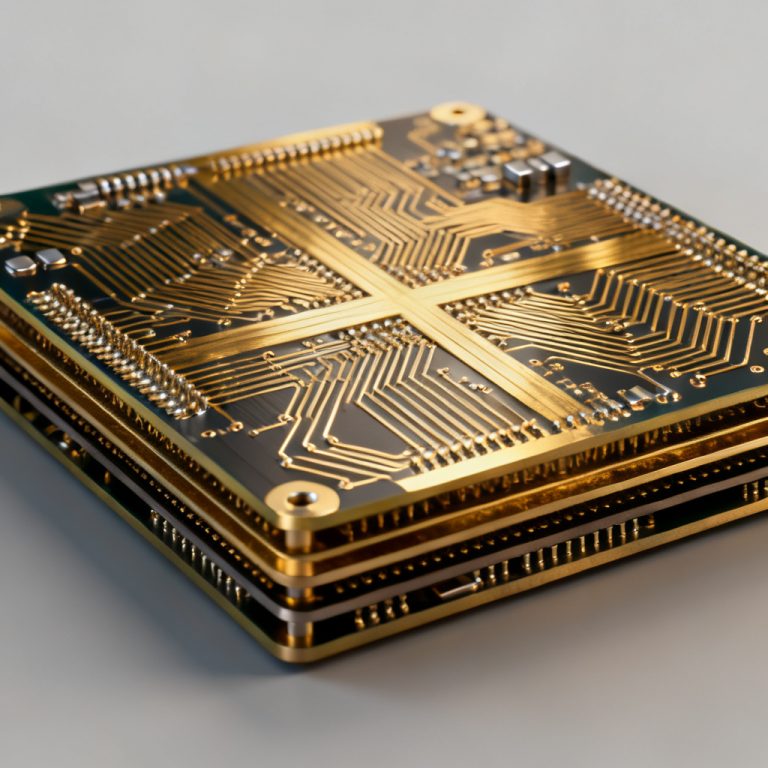
By using heavy copper on outer layers, you can replace multiple standard layers dedicated to power distribution. A 6-layer board with 2oz copper can be replaced by a 4-layer board with 10oz copper, achieving the same current capacity with better thermal performance in 10oz 20oz Heavy Copper PCB: High Current Power Boards.
Manufacturing Challenges for 10oz 20oz Heavy Copper PCB: High Current Power Boards
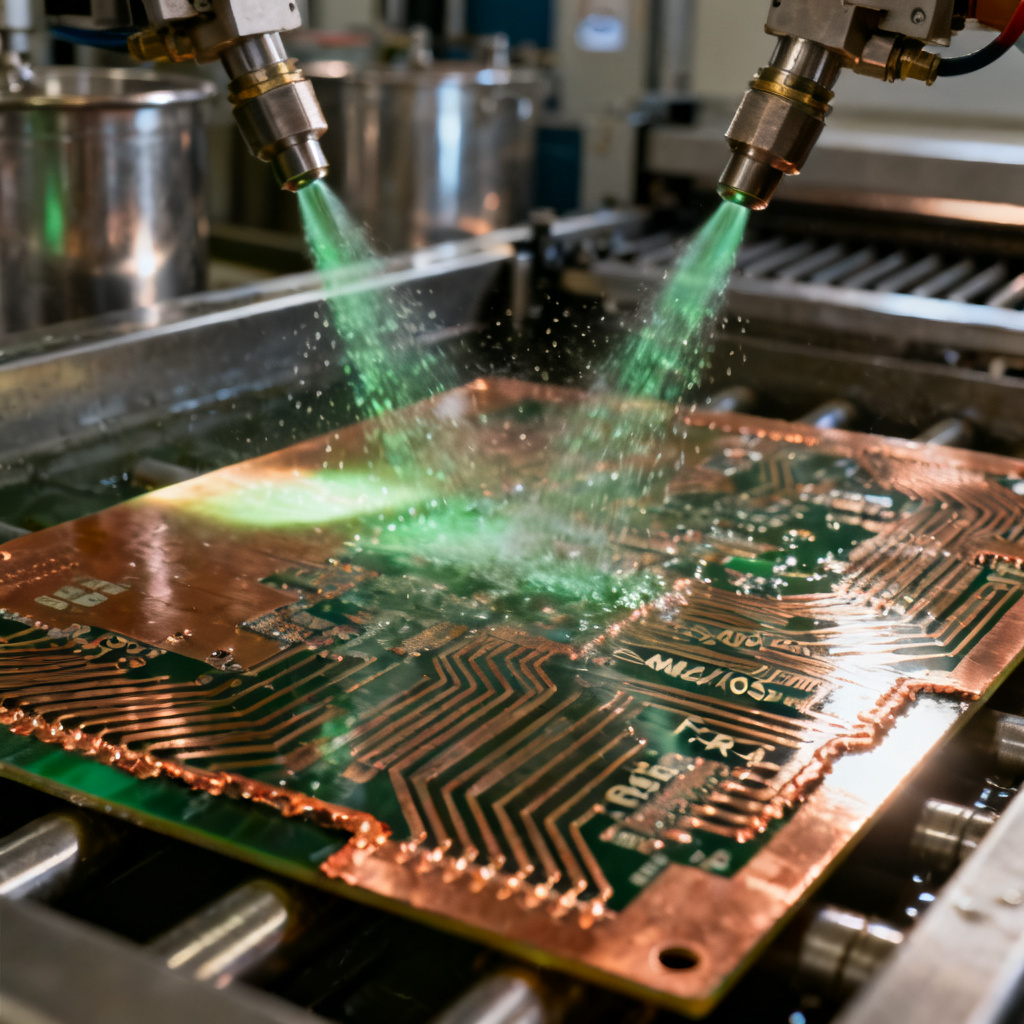
Producing 10oz 20oz Heavy Copper PCB: High Current Power Boards requires specialized techniques. Etching 20oz copper leads to undercut, where etchant removes sidewall copper. Manufacturers use high-pressure etching and bottom-up techniques to mitigate this.
Drillability and Plating for High Current Power Boards
Drilling through 20oz copper causes drill bit wear and burr formation. For 10oz 20oz Heavy Copper PCB: High Current Power Boards, plated through-holes must be thick enough to carry current. Sequential lamination or cap plating builds up copper in the hole to match heavy copper layers.
Solder Mask and Surface Finish for High Current Power Boards
Applying solder mask over 20oz copper is difficult due to sharp trace edges. For 10oz 20oz Heavy Copper PCB: High Current Power Boards, solutions include tenting vias with high-build solder mask or using ENIG finish. Specify thicker solder mask (1.5-2 mils over copper edges) to prevent peeling.
Lamination and Bonding for High Current Power Boards
Thick copper layers create non-uniform surfaces, challenging prepreg bonding. Manufacturers use higher lamination pressure and longer cure cycles for 10oz 20oz Heavy Copper PCB: High Current Power Boards. Specialized prepreg with high resin content fills gaps around thick copper traces.
Design Guidelines for 10oz 20oz Heavy Copper PCB: High Current Power Boards
To ensure manufacturability of 10oz 20oz Heavy Copper PCB: High Current Power Boards, follow these critical guidelines:
Trace Width and Spacing for High Current Power Boards
For 10oz copper, use minimum trace width of 0.020″ (0.5mm) for general traces, increasing to 0.030″ (0.75mm) for high-current paths. For 20oz copper, minimum width is 0.030″ (0.75mm) for signal and 0.040″ (1.0mm) for power. Maintain spacing of 0.020″ for 10oz and 0.030″ for 20oz to prevent arcing in 10oz 20oz Heavy Copper PCB: High Current Power Boards.
Thermal Management Design for High Current Power Boards
Use arrays of small thermal vias (0.012″ diameter) under power components to conduct heat to inner planes. For 10oz 20oz Heavy Copper PCB: High Current Power Boards, ensure vias are properly plated (1oz minimum) and not tented. Use solid copper pours instead of single traces to maximize heat spreading.
Layer Stackup for High Current Power Boards
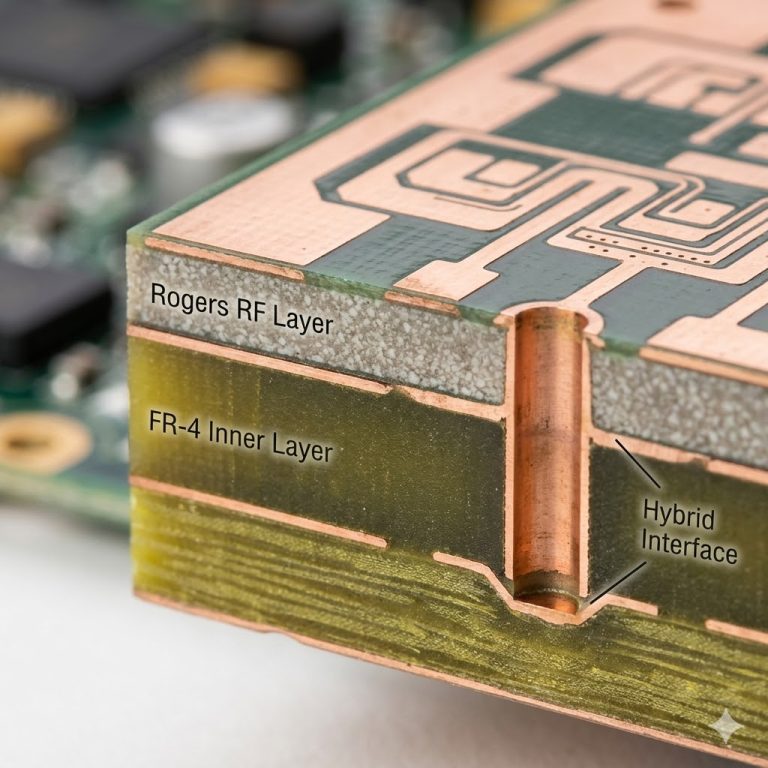
Use 10oz or 20oz copper on outer layers for high-current paths. For inner layers, use 2oz or 3oz for power distribution and 1oz for signals. For 20oz outer layers, standard core-based stackup is sufficient. Inner-layer heavy copper (e.g., 10oz on layer 3) requires sequential lamination for 10oz 20oz Heavy Copper PCB: High Current Power Boards.
Solder Mask and Silkscreen for High Current Power Boards
Specify high-build solder mask (1.5-2 mils over copper edges) to prevent copper exposure at trace edges. For 20oz copper, consider liquid photoimageable solder mask applied in multiple passes. Avoid placing silkscreen over heavy copper traces in 10oz 20oz Heavy Copper PCB: High Current Power Boards.
Applications of 10oz 20oz Heavy Copper PCB: High Current Power Boards
10oz 20oz Heavy Copper PCB: High Current Power Boards are indispensable in several key industries:
Electric Vehicle Power Distribution
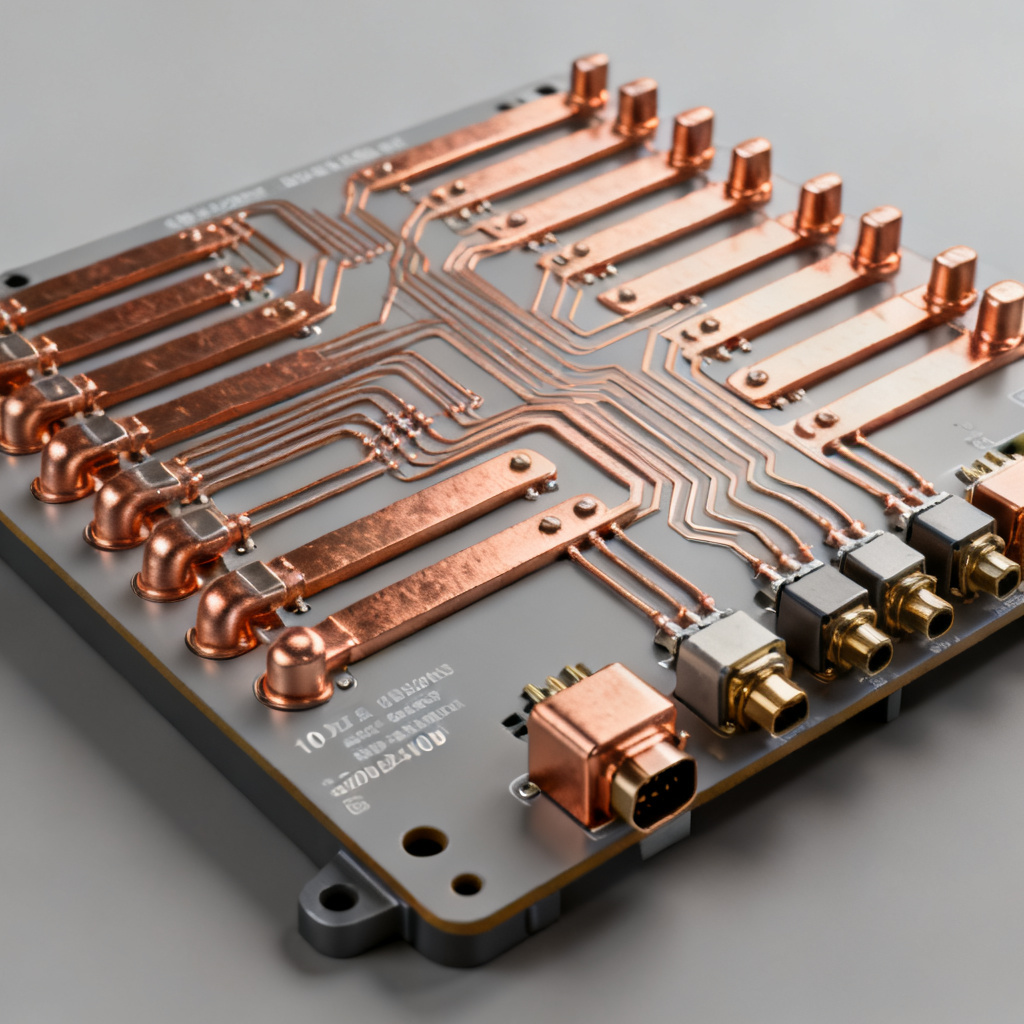
In EV battery management systems, 10oz copper handles high charge/discharge currents. DC-DC converters and inverters use 20oz copper for main power rails, reducing losses. On-board chargers benefit from efficient power transfer in 10oz 20oz Heavy Copper PCB: High Current Power Boards.
Industrial Motor Drives and Power Supplies
Variable frequency drives use 10oz and 20oz boards to carry current to IGBT modules. Uninterruptible power supplies handle surge currents during outages. Welding equipment requires 20oz copper for high-current output stages in 10oz 20oz Heavy Copper PCB: High Current Power Boards.
Renewable Energy Systems
Solar inverters use heavy copper boards for DC-to-AC conversion, handling up to 100A+. Wind turbine converters use 20oz copper in power electronics. Energy storage systems rely on heavy copper PCBs for current balancing in 10oz 20oz Heavy Copper PCB: High Current Power Boards.
Aerospace and Defense
Radar and communication systems use heavy copper for high current in power amplifiers. Satellite power systems benefit from 10oz copper reliability in extreme thermal cycling. 10oz 20oz Heavy Copper PCB: High Current Power Boards are essential for aerospace applications.
Testing and Quality Assurance for 10oz 20oz Heavy Copper PCB: High Current Power Boards
To ensure 10oz 20oz Heavy Copper PCB: High Current Power Boards meet demands, rigorous testing is required:
| Test Type | Specification for 10oz 20oz Heavy Copper PCB: High Current Power Boards |
|---|---|
| IPC-6012 Class 2 or 3 | Class 3 requires 100% electrical testing and stricter acceptance criteria for plating and etching. |
| Cross-Section Analysis | Verifies copper thickness, plating thickness in vias, and bond integrity. 20oz boards must show clean, uniform profile. |
| Thermal Shock Testing | Boards subjected to -55°C to +125°C to test for delamination or trace lifting. |
| Current Capacity Testing | Tested at rated current to verify temperature rise. 10oz board should not exceed 30°C rise above ambient. |
| Impedance and Continuity | 100% electrical testing ensures all traces and vias are intact with correct resistance. |
Choosing the Right Manufacturer for 10oz 20oz Heavy Copper PCB: High Current Power Boards
When sourcing 10oz 20oz Heavy Copper PCB: High Current Power Boards, look for:
- Experience: A manufacturer with proven track record in heavy copper (10+ years).
- Capabilities: Capability to etch up to 20oz or more, with sequential lamination for inner-layer heavy copper.
- Certifications: ISO 9001, IATF 16949 (automotive), and IPC-6012 Class 3 certification.
- Testing: In-house cross-section, thermal shock, and electrical testing.
- Lead Time: Heavy copper boards typically require 2-4 weeks longer than standard boards.
FAQ: 10oz 20oz Heavy Copper PCB: High Current Power Boards
What is the difference between 10oz and 20oz heavy copper PCB for high current power boards?
10oz copper (350 µm) carries approximately 50-60 amps per inch, while 20oz copper (700 µm) handles over 100 amps per inch. The choice depends on your current requirements for 10oz 20oz Heavy Copper PCB: High Current Power Boards.
How do I design a 20oz heavy copper PCB for high current power boards?
Use minimum trace width of 0.040″ for power paths, maintain spacing of 0.030″, and use solid copper pours. Ensure thermal vias are properly plated. Follow IPC-2152 for ampacity calculations in 10oz 20oz Heavy Copper PCB: High Current Power Boards.
What are the manufacturing challenges for 20oz heavy copper PCB?
Challenges include etching undercut, drill bit wear, solder mask adhesion, and lamination bonding. Manufacturers use high-pressure etching, sequential lamination, and high-build solder mask to overcome these issues in 10oz 20oz Heavy Copper PCB: High Current Power Boards.
What applications use 10oz heavy copper PCB?
10oz heavy copper PCBs are used in EV battery management systems, DC-DC converters, solar inverters, and industrial motor drives. They are ideal for medium-to-high power applications in 10oz 20oz Heavy Copper PCB: High Current Power Boards.
How do I test a heavy copper PCB for high current power boards?
Perform cross-section analysis to verify copper thickness, thermal shock testing for delamination, and current capacity testing to check temperature rise. IPC-6012 Class 3 standards ensure reliability in 10oz 20oz Heavy Copper PCB: High Current Power Boards.
Conclusion: Power Your Future with 10oz 20oz Heavy Copper PCB: High Current Power Boards
10oz 20oz Heavy Copper PCB: High Current Power Boards are the engineering backbone of modern high-power electronics. By integrating high current capacity, superior thermal management, and mechanical robustness directly into the PCB, they eliminate bulky external wiring and heat sinks. Whether designing a 50A EV battery management board or a 200A industrial power supply, understanding these specifications is essential. Partner with an experienced manufacturer to ensure optimal performance.
Ready to start your heavy copper PCB project? Contact our engineering team today for a free DFM review and competitive quote on 10oz and 20oz boards. We specialize in high-reliability, high-current power boards for demanding applications.